Back to Blogs
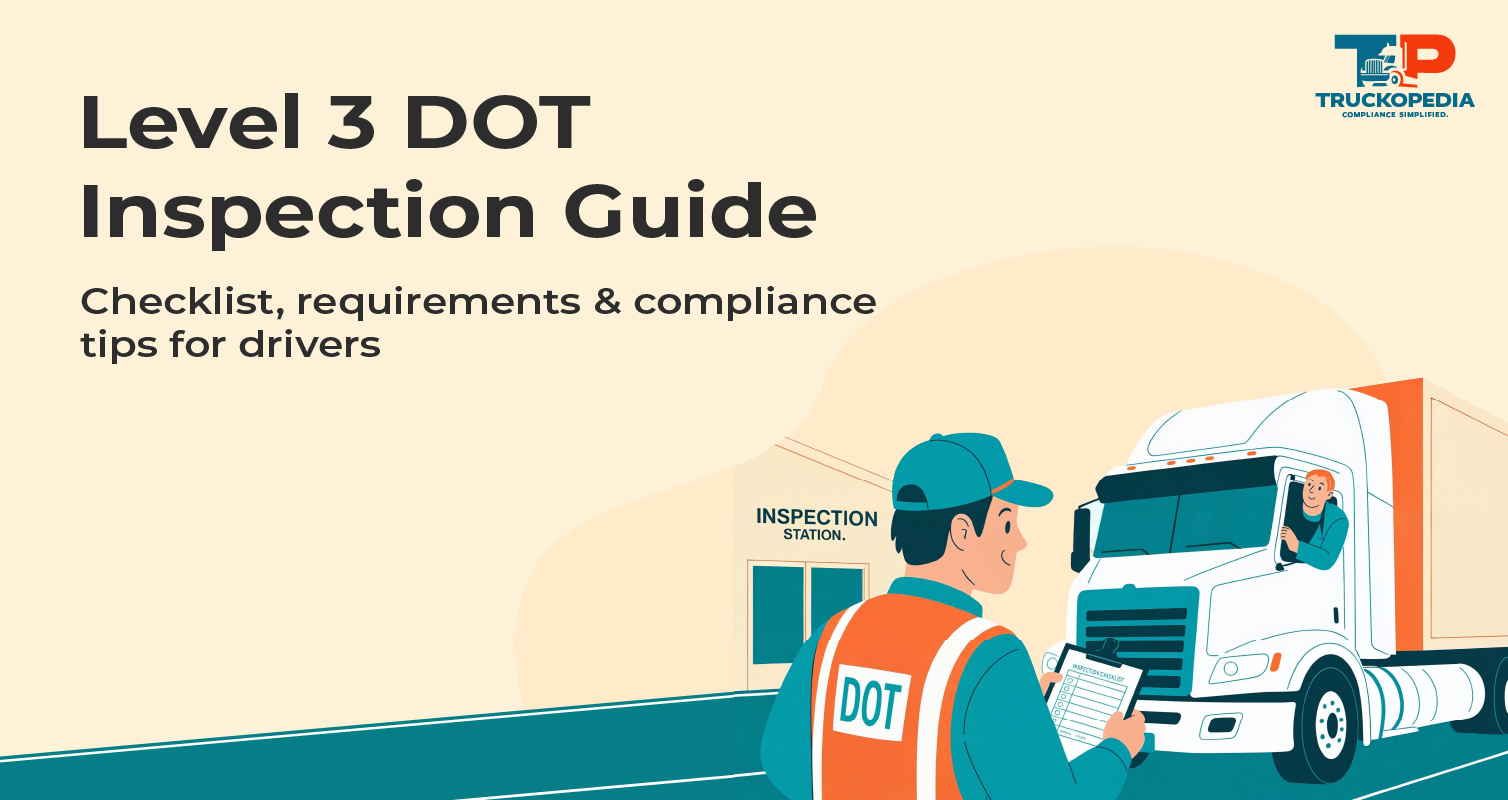
A Level 3 DOT inspection, also called a driver-only inspection, focuses on the driver rather than the vehicle. During this inspection, enforcement officers review your credentials, required documents, and compliance with Federal Motor Carrier Safety Administration (FMCSA) regulations.
Unlike other roadside inspections that examine vehicle equipment and mechanical components, a DOT Level 3 inspection checks whether the driver is properly qualified and operating within federal safety rules. Officers typically verify items such as your commercial driver’s license (CDL), medical certificate, hours-of-service records, and other required documentation.
Although it’s one of the less intrusive DOT inspections, failing a Level 3 DOT inspection can still lead to violations, penalties, or delays. That’s why understanding what a Level 3 DOT inspection consists of and preparing your documents in advance is essential.
In this guide, you’ll learn what a Level 3 inspection includes, the key documents officers check, common violations, and how to prepare using a Level 3 DOT inspection checklist.
What is a level 3 DOT inspection?
A Level 3 DOT Inspection, also called a Driver-Only or Credential Inspection, is a roadside review that focuses entirely on the driver, not the vehicle. Enforcement officers from the Federal Motor Carrier Safety Administration (FMCSA) or state agencies conduct this inspection to verify that commercial drivers meet all required safety regulations.
Unlike Level 1 or Level 2 inspections, which examine the truck and its mechanical components, a DOT Level 3 inspection evaluates the driver’s qualifications, documentation, and hours-of-service compliance. You can think of it as the commercial trucking equivalent of being pulled over for a routine traffic check—but with a far more detailed review of your credentials.
A typical Level 3 inspection takes about 15 minutes; however, the process may take longer if the inspector identifies discrepancies or violations. Once the inspection concludes, the officer issues a Driver Vehicle Examination Report (DVER). You must retain this report and submit it to your motor carrier as required.
During the inspection, an officer evaluates key Driver Qualification (DQ) file components, including:
- Your valid Commercial Driver’s License (CDL)
- Medical Examiner’s Certificate
- Hours-of-Service (HOS) records
- Record of Duty Status (RODS) or electronic logging device (ELD) data
- Any required endorsements or permits
DOT Level 3 inspection checklist: What inspectors look for
What does a Level 3 Inspection consist of?
A Level 3 DOT Inspection follows the North American Standard Level III Driver/Credential/Administrative Inspection Procedure developed by the Commercial Vehicle Safety Alliance (CVSA). Law enforcement officers across the United States conduct these inspections in coordination with the Federal Motor Carrier Safety Administration (FMCSA).
Although inspectors do not physically examine the vehicle, they conduct a detailed review of the driver’s qualifications, compliance records, and supporting documentation. The goal is to confirm that both the driver and the motor carrier meet federal safety regulations.
What inspectors check during a level 3 DOT inspection
A Level 3 inspection typically includes the following:
- Carrier identification and operating status – The officer verifies the motor carrier’s legal authority and current status.
- Driver’s license – The inspector confirms that your CDL is valid and matches the class of vehicle you are operating.
- English language proficiency –Drivers must be able to read and speak English sufficiently to communicate with enforcement officers and understand traffic signs, as required by federal regulations.
- Medical Examiner’s Certificate – You must provide proof of a valid DOT medical certification. (Medical certificate procedures are scheduled to change in 2026.)
- Skill Performance Evaluation (SPE) certificate – Drivers with certain physical impairments may need an SPE certificate issued under a federal exemption program.
- Hours-of-Service (HOS) compliance – The officer reviews your driving and rest periods to ensure compliance with federal HOS limits.
- Record of duty status (RODS) – You must present logs in paper form or through a compliant Electronic Logging Device (ELD).
- ELD supporting documents – Inspectors may also request:
- The ELD user manual
- Instructions for data transfer
- Malfunction reporting procedures
- Eight days’ worth of blank RODS logs (as backup)
- Seat belt usage – The officer checks that you wear a seat belt at the time of inspection.
- Recent Vehicle Inspection Reports (VIRs) – You must provide daily vehicle inspection reports documenting prior vehicle conditions.
- HAZMAT endorsements and documentation – Required if you transport hazardous materials.
- Drug and Alcohol Clearinghouse status – The officer may verify compliance at their discretion.
Even without a physical vehicle examination, this inspection remains comprehensive. Staying organized, keeping documents up to date, and maintaining accurate logs help ensure you pass the inspection without violations.
What else may be checked during a Level 3 roadside inspection?
In addition to the standard credential review, inspectors may examine a few additional compliance areas during a Level 3 roadside inspection.
Officers often verify a driver’s status in the FMCSA Drug and Alcohol Clearinghouse to confirm that the driver is eligible to operate in interstate commerce. While this check is not mandatory in every inspection, it is commonly performed to ensure full regulatory compliance.
Inspectors also frequently request the four required ELD compliance documents. Drivers must be prepared to provide:
- The ELD user instruction manual
- ELD data transfer instructions
- ELD malfunction reporting procedures
- Eight days of blank paper Record of Duty Status (RODS) logs
These documents must be readily accessible in the vehicle at all times.
Finally, an inspection can escalate if the officer observes a visible vehicle safety issue while approaching the truck. For instance, a flat tire, an audible air leak, or another obvious mechanical defect may prompt the officer to move beyond a Level 3 inspection and conduct a more comprehensive inspection level.
Where and when do Level 3 DOT inspections happen?
Law enforcement officers conduct Level 3 inspections anywhere they can safely pull a commercial motor vehicle (CMV) off the road. Common locations include:
- Roadside inspection sites
- Weigh stations
- Random safety checkpoints
However, these inspections most frequently take place during routine roadside stops.
Officers often initiate a Level 3 inspection after observing a traffic violation or unsafe driving behavior. Swerving between lanes, failing to wear a seat belt, or using a mobile phone while driving can quickly draw attention and trigger a stop. In some cases, inspections also occur as part of routine enforcement efforts, even if no obvious violation has occurred.
If the inspector identifies a compliance issue during the review, they may place the driver out of service until the problem is corrected. In addition, an officer may initially plan to conduct only a Level 3 inspection but escalate it to a Level 2 or even a Level 1 inspection if they notice visible vehicle defects—such as a flat tire or an audible air leak while approaching the truck.
How is a Level 3 roadside inspection different?
A Level 3 roadside inspection differs from other DOT inspections because it focuses exclusively on the driver—not the truck or trailer. Inspectors use this inspection type to verify driver qualifications and regulatory compliance, particularly hours-of-service (HOS) adherence and required credentials.
Unlike a Level 2 (Walk-Around Driver/Vehicle Inspection) or a Level 1 (North American Standard Inspection), a Level 3 inspection does not include a physical examination of the commercial motor vehicle. The officer reviews only the driver’s documentation, certifications, and compliance records. Because the vehicle itself is not inspected, drivers who pass a Level 3 inspection do not receive a CVSA decal.
When a Level 3 DOT Inspection Expands
In some situations, an officer may initially plan to conduct only a Level 3 DOT inspection focused on driver credentials. However, if the officer notices visible safety issues on the vehicle, the inspection may expand to include a broader review.
This can turn a simple driver-only inspection into a Level 2 walk-around inspection or even a Level 1 full inspection.
Common issues that may lead an officer to expand the inspection include:
- A visibly flat tire
- Audible air leaks
- Missing or malfunctioning lights
- Damaged or missing reflective tape
When inspectors spot obvious mechanical problems while approaching the truck, they have the authority to broaden the scope of the inspection immediately.
What happens after the Level II DOT inspection?
After the officer completes a Level 3 inspection, they issue a Driver Vehicle Examination Report (DVER) that documents the results of the review. The driver must promptly submit this report to the company’s compliance or safety manager for internal tracking and recordkeeping.
If the inspector notes any violations, address them immediately. Correct the issue, document the corrective action taken, and retain records as required. Quick response not only protects your compliance standing but also reduces the risk of repeat violations during future inspections.
Because Level 3 inspections focus solely on driver credentials and documentation—not the vehicle—officers do not issue CVSA decals for passing this inspection level.
What are the common Level 3 DOT inspection violations?
Officers frequently initiate a Level 3 roadside inspection after observing a traffic or regulatory violation. Because this inspection focuses on driver behavior and documentation, most violations fall into three main categories: unsafe driving, hours-of-service (HOS) compliance, and credential issues.
1. Unsafe driving violations
Unsafe driving remains the most common trigger for a Level 3 inspection. Typical violations include:
- Speeding (392.2S) — especially 6–10 mph over the speed limit, which ranks among the most cited offenses
- Failure to obey traffic control devices (392.2(c)) — such as running red lights or ignoring posted signs
- Lane restriction violations (392.2LV) — including improper use of restricted lanes
- Failure to wear a seat belt (392.16)
- Using a hand-held mobile phone while driving (392.82(a)(1))
These “gateway” violations often lead to the initial traffic stop that triggers the inspection.
2. Hours-of-Service (HOS) and logbook violations
Because Level 3 inspections include a review of Records of Duty Status (RODS) and ELD data, documentation errors frequently result in citations. Common violations include:
- False reports of a driver’s record of duty status (395.8(e))
- RODS form and manner violations (395.8)
- Failure to maintain required ELD backup documents
- Exceeding allowable driving time limits
Even minor logbook inaccuracies can result in penalties and negatively affect compliance scores.
3. Credential and qualification violations
Inspectors also review driver qualifications and required certifications. Frequent violations include:
- Operating a CMV without a valid CDL (383.23(a)(2))
- Operating a property-carrying vehicle without a valid medical certificate (391.41(a)(1))
- Missing or expired HAZMAT endorsements, when applicable
Although a Level 3 inspection does not include a physical vehicle examination, it remains thorough in its review of driver compliance. Violations affect not only the individual driver’s record but also the motor carrier’s safety and compliance scores.
How to prepare your fleet for Level 3 inspections?
Strong preparation helps fleets avoid delays, violations, and costly penalties during Level 3 inspections. Fleet managers who focus on training, documentation, and driver behavior significantly reduce their risk.
1. Train drivers thoroughly
Make sure every driver understands exactly what a Level 3 inspection involves. Drivers should:
- Keep all required documents readily accessible in the cab
- Know how to operate and present ELD data properly
- Follow Hours-of-Service (HOS) regulations accurately
Even a short refresher session can prevent costly mistakes. A 15-minute compliance review may save hours of downtime and prevent fines for sure.
2. Maintain required ELD and logbook documents
Drivers must carry specific ELD compliance materials at all times. Ensure each vehicle contains:
- A printed ELD instruction manual
- ELD data transfer instructions
- Malfunction reporting procedures
- At least eight days of blank paper Record of Duty Status (RODS) logs
Incorporate this document check into every pre-trip inspection to eliminate last-minute scrambling during a roadside stop.
3. Monitor driving behavior proactively
Unsafe driving often triggers Level 3 inspections. Use telematics and GPS monitoring tools to identify and correct risky behavior, such as:
- Speeding
- Harsh braking
- Hand-held cell phone use
Addressing these issues early reduces the likelihood of roadside stops and helps protect both your drivers and your compliance record.
Stay ready for every level 3 DOT inspection
A Level 3 DOT inspection may be brief and limited to driver credentials, but its impact on your fleet can be significant. Because it focuses entirely on qualifications, hours-of-service compliance, and documentation accuracy, it gives enforcement officers a direct snapshot of your safety culture and regulatory discipline.
Frequent roadside stops, high driver violation rates, and the potential for inspection escalation make preparation essential. When drivers maintain up-to-date credentials, manage ELD records correctly, and follow traffic laws consistently, they reduce both compliance risks and operational disruptions.
In the end, success during a Level 3 inspection comes down to proactive training, organized paperwork, and responsible driving behavior. Treat every trip as inspection-ready, and your fleet will stay compliant, confident, and moving forward without unnecessary setbacks.
Level 3 DOT inspection – Frequently asked questions
How long does a level 3 inspection take?
A Level 3 inspection typically lasts 15 to 30 minutes. The exact duration depends on how quickly the driver can present documents, access ELD records, and whether the officer identifies any violations.
What documents do officers check during a level 3 DOT inspection?
During a Level 3 inspection, officers review key driver credentials and compliance records. Be prepared to present:
- Commercial Driver’s License (CDL), including endorsements and restrictions
- Medical Examiner’s Certificate (MEC) or proof of medical certification status linked to your CDL (as required by your state)
- Hours-of-Service (HOS) logs
- Record of Duty Status (RODS) or ELD records
- Shipping papers or Bill of Lading (BOL)
- Proof of insurance
- Vehicle registration
- IFTA and IRP credentials
- Required permits (if applicable)
Inspectors carefully examine these documents to confirm that you meet federal and state regulations. Failure to comply can result in fines, operational delays, or damage to your safety record.
What ELD items do officers review in Level 3 inspections?
When reviewing ELD data, officers verify:
- Current duty status
- Drive-time limits
- 7/8-day cumulative totals
- Required 30-minute breaks
- Log annotations and edits
- Unassigned driving events
- The device’s ability to transfer logs (via wireless/web services or on-screen display/print)
Drivers must know how to access and transfer ELD records on demand.
Do officers check medical cards during DOT inspections?
Yes. Officers confirm that you meet medical qualification requirements. They verify that your Medical Examiner’s Certificate is valid and properly linked to your CDL when required. If your state still requires drivers to carry a physical card, keep it in the cab and ensure your CDL reflects “medically certified” status.
Will a Level 3 inspection affect the CSA score?
Yes. Driver-related violations found during a Level 3 inspection impact relevant BASIC categories, such as:
- Hours of Service (HOS) Compliance
- Driver Fitness
- Controlled Substances/Alcohol
A clean inspection improves your CSA profile and may positively influence your Inspection Selection System (ISS) score.
How to pass a Level 3 inspection?
Complete a quick paperwork-focused pre-trip check. Confirm:
- CDL and medical certification status
- Registration, IFTA, IRP, and permits
- Insurance documentation
- Organized and accurate BOLs
- ELD is logged in, functioning properly, and up to date
Drivers should confidently navigate and transfer ELD logs during an inspection.
Can a Level 3 inspection lead to a vehicle inspection?
Yes. If an officer observes visible mechanical defects or suspects cargo issues, they may escalate the inspection to Level 2 or Level 1, which includes a physical vehicle examination.
What happens after a clean level 3 inspection?
If you pass without violations, the officer issues an inspection report documenting a clean result. This outcome strengthens your compliance record and CSA profile. Retain a copy for your files—many carriers recognize clean inspections as part of driver safety incentive programs.