Back to Blogs
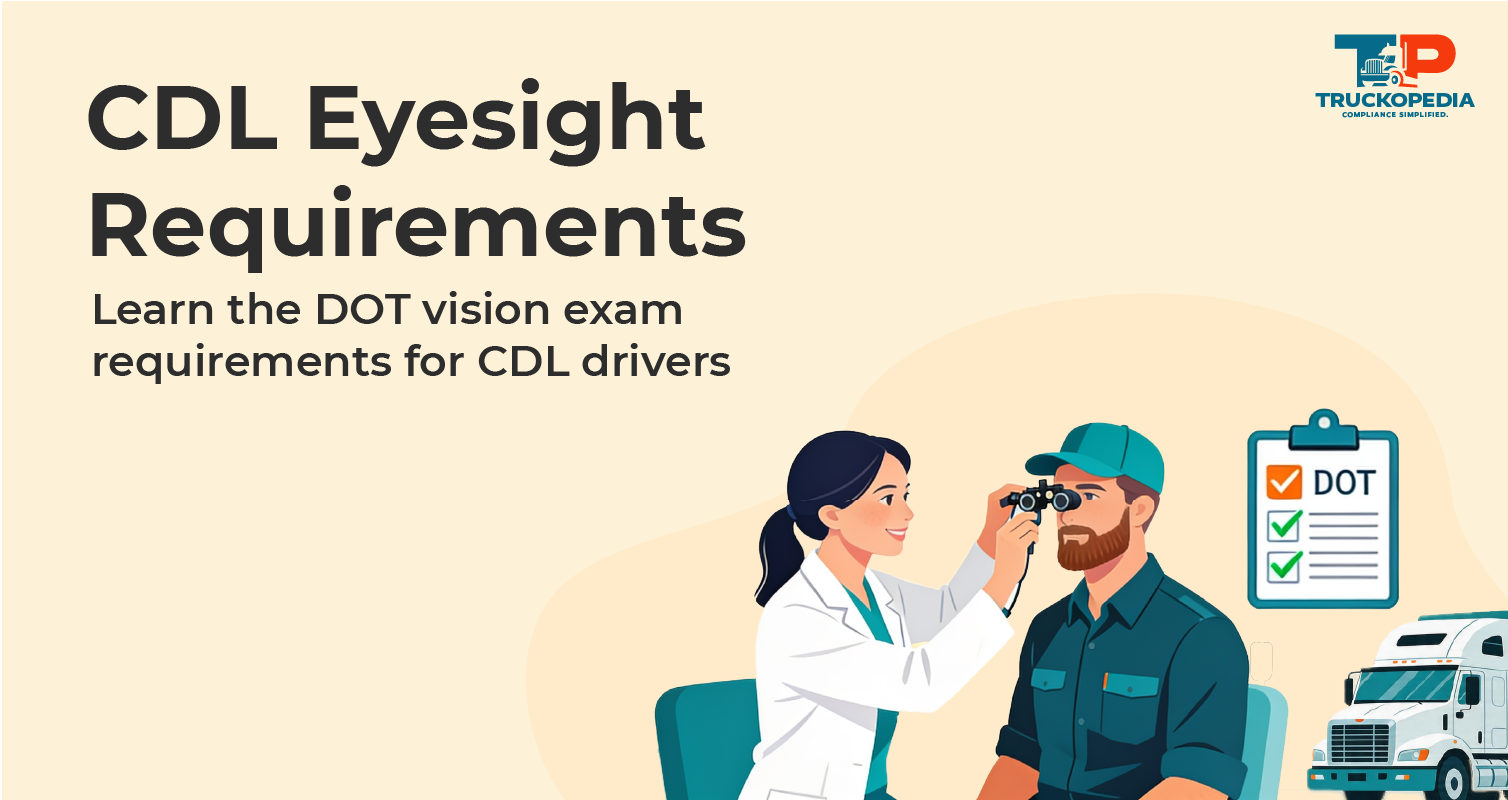
Clear vision is one of the most important requirements for safely operating a commercial motor vehicle (CMV). Commercial drivers rely on clear vision to read traffic signs, monitor surrounding vehicles, recognize hazards, and respond safely to changing road conditions. For interstate commercial drivers subject to federal medical qualification rules, the Federal Motor Carrier Safety Administration (FMCSA) establishes minimum vision standards.
Vision is evaluated as part of the DOT physical by a certified Medical Examiner. The examination checks visual acuity, peripheral vision, and the ability to recognize standard traffic signal colors. Drivers may use prescription glasses or contact lenses to meet the requirements.
Some drivers who do not meet the standard in one eye may still qualify under the FMCSA Alternative Vision Standard. This guide explains the current CDL vision requirements, what happens during the DOT vision test, how corrective lenses affect certification, and what options may be available if you do not initially meet the standard.
What Are the Vision Requirements to Get Your CDL?
Interstate commercial drivers who are subject to federal medical certification must meet the FMCSA’s vision requirements. These standards measure whether you can see clearly at a distance, detect objects within your field of vision, and recognize the colors used in traffic signals.
Driving a commercial truck requires constant visual awareness. Drivers must be able to identify traffic signs from a distance, monitor mirrors and surrounding traffic, recognize pedestrians and cyclists, judge following distances, and react quickly to unexpected hazards. Good vision becomes even more critical when driving at highway speeds, during nighttime operations, or in adverse weather conditions.
Your vision is evaluated during the DOT physical. You may wear prescription glasses or contact lenses if needed to meet the standard. Drivers who do not meet the standard in one eye may still qualify under the FMCSA Alternative Vision Standard.
What Are the Current FMCSA CDL Vision Standards?
The FMCSA has established minimum vision standards that all interstate commercial drivers must satisfy unless they qualify under the Alternative Vision Standard. These requirements help ensure drivers have the visual ability needed to safely operate commercial vehicles on public roads.
| Vision Standard | FMCSA Requirement |
|---|---|
| Visual acuity in each eye | At least 20/40 in each eye separately, with or without corrective lenses |
| Binocular visual acuity | At least 20/40 with both eyes together, with or without corrective lenses |
| Field of vision | At least 70 degrees in the horizontal meridian in each eye |
| Color recognition | Ability to recognize red, green, and amber traffic signal colors |
Drivers may use prescription glasses or contact lenses to meet the visual-acuity requirements. If corrective lenses are needed to qualify, the driver must wear them while operating a commercial motor vehicle.
Let’s take a closer look at each requirement.
Visual Acuity
Visual acuity measures how clearly you can see at a distance. During the DOT vision exam, the Medical Examiner records your vision in each eye separately and with both eyes together.
To meet the standard vision requirements, you must have at least 20/40 distant visual acuity in each eye and with both eyes together. You may wear prescription glasses or contact lenses during the exam.
Field of Vision
Your field of vision, also called peripheral vision, allows you to detect vehicles, pedestrians, and other objects outside your direct line of sight.
FMCSA requires a field of vision of at least 70 degrees in the horizontal meridian in each eye. This helps drivers monitor surrounding traffic, change lanes, merge, and respond to hazards.
Color Recognition
Commercial drivers must be able to recognize the colors of traffic signals and devices showing standard red, green, and amber.
The federal standard does not require perfect color vision. The Medical Examiner must determine whether you can correctly recognize the colors used in traffic-control signals and devices.
Corrective Lenses
You may use prescription glasses or contact lenses to meet the visual-acuity requirements.
If corrective lenses are necessary for you to qualify, the Medical Examiner records that requirement on your medical examination forms. You must wear the required lenses whenever you operate a commercial motor vehicle.
Drivers who do not meet the visual-acuity or field-of-vision standard in one eye may still qualify under the FMCSA Alternative Vision Standard.
Can You Get a CDL If You Have Bad Vision?
Poor eyesight does not automatically disqualify you from obtaining or maintaining a Commercial Driver’s License. Many drivers meet the FMCSA vision requirements by wearing prescription glasses or contact lenses during the DOT physical.
If corrective lenses allow you to meet the required visual-acuity standards, you may qualify for medical certification as long as you also satisfy the field-of-vision, color-recognition, and other DOT medical requirements.
If your vision cannot be corrected to meet the standard in one eye, you may still qualify under the FMCSA Alternative Vision Standard. Eligibility depends on your specific vision condition, whether it is stable, and the results of evaluations by an eye specialist and a certified Medical Examiner.
Common Vision Conditions That May Affect CDL Eligibility
Several eye conditions can affect your ability to meet the DOT vision requirements. While some conditions are temporary or treatable, others require additional medical evaluation before you can be certified.
Refractive Errors
Nearsightedness, farsightedness, and astigmatism can often be corrected with prescription glasses or contact lenses. These conditions generally do not prevent medical certification if your corrected vision meets the required standards.
Eye Conditions That Affect Vision
Cataracts, glaucoma, diabetic retinopathy, macular degeneration, and other retinal conditions may affect visual acuity, peripheral vision, night vision, or other aspects of sight.
The Medical Examiner may request an evaluation from an ophthalmologist or optometrist to determine how the condition affects your vision and whether you meet the federal requirements. FMCSA instructs Medical Examiners to consider underlying eye conditions and any vision changes when making a certification decision.
Vision Loss in One Eye
Drivers who do not meet the visual-acuity or field-of-vision requirement in one eye may still qualify under the FMCSA Alternative Vision Standard. This process is explained later in this guide.
Your eligibility depends on your test results, whether the condition is stable, and the Medical Examiner’s assessment of your overall ability to operate a commercial vehicle safely. Under the Alternative Vision Standard, the vision deficiency must be stable, and enough time must have passed for the driver to adapt to the change.
Can Corrective Lenses Help You Qualify?
Yes. You may wear prescription glasses or contact lenses during the DOT vision examination. If corrective lenses allow you to meet the visual-acuity requirements, the Medical Examiner will record that they are required, and you must wear them whenever operating a commercial motor vehicle.
What If Your Vision Does Not Meet the Standard?
Failing the initial vision screening does not always result in permanent disqualification. Depending on the cause, you may be able to qualify after:
- Updating your glasses or contact-lens prescription
- Receiving treatment for a correctable eye condition
- Completing an additional evaluation with an ophthalmologist or optometrist
- Returning for another DOT physical after your vision improves
If you do not meet the visual-acuity or field-of-vision requirement in one eye, you may qualify under the FMCSA Alternative Vision Standard. An ophthalmologist or optometrist must complete Form MCSA-5871, and the DOT physical must begin within 45 days after the form is signed. The certified Medical Examiner then determines whether you meet the alternative standard and the other federal medical requirements.
The Alternative Vision Standard replaced the former federal Vision Exemption Program in March 2022.
How Often Do You Have to Get Your Eyes Checked to Maintain a CDL?
Your vision is checked each time you complete a DOT physical. A Medical Examiner’s Certificate may be valid for up to 24 months, so many drivers are tested once every two years.
A Medical Examiner may issue a certificate for a shorter period if a medical or vision condition requires closer monitoring. Drivers whose vision depends on prescription glasses or contact lenses should also schedule regular comprehensive eye exams with an optometrist or ophthalmologist between DOT physicals.
It’s also important to have your eyes examined promptly if you notice changes such as blurred vision, difficulty reading road signs, reduced night vision, increased sensitivity to light, blind spots, or trouble judging distances.
How to Prepare for the DOT Vision Test
Preparing for the DOT vision test is straightforward. Before your appointment:
- Wear your current glasses or contact lenses. If you need corrective lenses to meet the vision standard, the Medical Examiner will test you while you are wearing them.
- Make sure your prescription is current. Consider scheduling an eye exam before your DOT physical if your vision has changed or your current prescription no longer works well.
- Bring relevant vision records. If you recently had eye surgery or are being treated for an eye condition, bring any documents requested by the Medical Examiner.
- Bring Form MCSA-5871 if required. Drivers applying under the FMCSA Alternative Vision Standard must provide a completed Vision Evaluation Report signed by an ophthalmologist or optometrist. The DOT physical must begin within 45 days after the form is signed.
- Report significant vision changes. Tell the Medical Examiner about blurred or double vision, reduced peripheral vision, or other recent changes that could affect safe driving.
Having current corrective lenses and any required documentation ready can help prevent delays in completing your DOT physical.
What Happens During the DOT Vision Test?
The Medical Examiner evaluates your distance vision, field of vision, and ability to recognize traffic signal colors. Each eye is tested separately, and your distance vision is also tested with both eyes together.
What Eye Chart Is Used in the DOT Physical?
Medical Examiners commonly use a Snellen eye chart or a Titmus Vision Tester to measure distance vision. If another testing method is used, the results must be recorded in values comparable to the Snellen scale.
For distance vision, 20 feet is treated as the standard testing distance. You may wear prescription glasses or contact lenses during the test if you need them to meet the FMCSA vision requirements.
To meet the standard, you must have at least 20/40 distance vision in each eye separately and with both eyes together, with or without corrective lenses.
Color Vision Requirements for CDL Drivers
The Medical Examiner must also determine whether you can recognize the red, green, and amber colors used in traffic signals and control devices.
Color recognition may be evaluated using a standard color-vision test or a controlled test using red, green, and amber objects or signals. You do not need perfect color vision, but you must be able to correctly recognize these three standard colors.
This requirement also applies to drivers seeking certification under the FMCSA Alternative Vision Standard.
What Employers Should Know About CDL Vision Requirements
Motor carriers must ensure that drivers subject to FMCSA medical requirements are medically qualified before allowing them to operate a commercial motor vehicle. A certified Medical Examiner determines whether a driver meets the federal vision standards or qualifies under the Alternative Vision Standard.
For CDL and Commercial Learner’s Permit holders, employers must obtain the driver’s motor vehicle record from the licensing state to verify current medical certification status. This record must be kept in the driver’s qualification file. If a driver has an FMCSA medical variance, the related documentation must also be maintained.
Employers should monitor certification expiration dates and confirm that each driver’s medical status remains current before assigning driving duties.
What Happens If You Fail the DOT Vision Test?
Failing the DOT vision test doesn’t necessarily mean the end of your commercial driving career. The next steps depend on why you didn’t meet the FMCSA vision standards and whether the condition is temporary, correctable, or permanent. In many cases, drivers can address the issue and return for another evaluation.
Here are the most common outcomes if you don’t pass the DOT vision exam:
Update Your Corrective Lenses
If your vision falls below the required 20/40 visual acuity, the Medical Examiner may recommend visiting an optometrist or ophthalmologist to obtain an updated prescription. Many drivers pass the vision test after getting new glasses or contact lenses and returning for a follow-up examination.
Seek Treatment for Eye Conditions
If an underlying eye condition—such as cataracts, glaucoma, or diabetic retinopathy—is affecting your vision, you may need medical treatment before you can be certified. Depending on the condition, treatment may improve your eyesight enough to meet the FMCSA vision requirements.
Undergo Additional Vision Evaluation
If your vision issue cannot be corrected with prescription lenses alone, the Medical Examiner may refer you to an eye specialist for a comprehensive evaluation. The specialist will assess your visual acuity, peripheral vision, and overall eye health and provide documentation regarding your ability to safely operate a commercial motor vehicle.
Qualify Under the FMCSA Alternative Vision Standard
Drivers with vision loss in one eye or certain permanent vision conditions may still be eligible to obtain or maintain a CDL under the FMCSA Alternative Vision Standard. To qualify, you’ll generally need to complete a Vision Evaluation Report (Form MCSA-5871) with an ophthalmologist or optometrist. A certified Medical Examiner will then review the report and determine whether you can be medically certified to drive a commercial vehicle safely.
Return for a New DOT Physical
Once your vision has improved or you’ve completed any required evaluations or treatment, you can schedule another DOT physical. If you meet the FMCSA vision standards during the follow-up examination, the Medical Examiner may issue or renew your Medical Examiner’s Certificate.
How Does the FMCSA Alternative Vision Standard Work?
Drivers who do not meet the visual-acuity or field-of-vision requirement in one eye may still qualify under the FMCSA Alternative Vision Standard. This process replaced the former federal Vision Exemption Program effective March 22, 2022.
To qualify, the driver must first have an ophthalmologist or optometrist complete the Vision Evaluation Report (Form MCSA-5871). The vision deficiency must be stable, and enough time must have passed for the driver to adapt to the change.
A certified Medical Examiner must begin the DOT physical within 45 days after the eye specialist signs the form. The examiner reviews the report, confirms that the driver meets the Alternative Vision Standard and all other federal medical requirements, and determines whether to issue a Medical Examiner’s Certificate.
Drivers certified under this standard must complete a new vision evaluation and DOT physical at least once every 12 months. The Medical Examiner’s Certificate may be issued for no more than one year.
A driver qualifying under the standard for the first time may also need to pass a road test administered by a motor carrier before operating a commercial vehicle. Exceptions apply to certain drivers with previous qualifying experience or prior federal vision credentials.
Can You Pass the DOT Eye Exam With Glasses or Contacts?
Yes. You may wear prescription glasses or contact lenses during the DOT vision test. If they allow you to meet the required visual-acuity standards, you may qualify for medical certification as long as you meet the other DOT medical requirements.
If corrective lenses are required, the Medical Examiner will record that requirement on your medical certification. You must wear your glasses or contacts whenever operating a commercial motor vehicle.
Wear your current prescription lenses to the DOT physical. If your vision has changed or your prescription is no longer effective, schedule an eye exam before your appointment.
Tips for Drivers Who Wear Glasses or Contacts
To avoid problems during your DOT physical or while driving:
- Wear your current prescription glasses or contact lenses to your DOT physical.
- Make sure your prescription is up to date before your medical exam.
- Inform the Medical Examiner that you use corrective lenses.
- Carry a spare pair of prescription glasses if you normally wear them, especially during long trips.
Keep Your Vision Clear and Your CDL Current
Meeting the FMCSA vision standards is an important part of obtaining and maintaining your medical certification. Many drivers qualify with glasses or contact lenses, while some drivers with vision loss in one eye may qualify under the Alternative Vision Standard.
Keep your prescription current and address significant vision changes before your next DOT physical. Preparing early can help you avoid certification delays and remain qualified to drive.
Frequently Asked Questions
Can You Pass the DOT Eye Exam With Glasses or Contacts?
Yes. You may wear prescription glasses or contact lenses during the DOT vision test. If corrective lenses help you meet the required visual-acuity standards, your medical certification will indicate that you must wear them while operating a commercial motor vehicle.
Can You Get a CDL With Vision in One Eye?
Possibly. Drivers who do not meet the visual-acuity or field-of-vision requirement in one eye may qualify for medical certification under the FMCSA Alternative Vision Standard.
An ophthalmologist or optometrist must complete Form MCSA-5871, and a certified Medical Examiner makes the final certification decision.
Is Peripheral Vision Tested During the DOT Physical?
Yes. Under the standard FMCSA requirements, drivers must have a field of vision of at least 70 degrees in the horizontal meridian in each eye.
What Happens If My Vision Is Below 20/40?
You may be able to meet the standard with updated glasses or contact lenses. If you still do not have 20/40 vision in one eye, you may qualify under the Alternative Vision Standard.
The Alternative Vision Standard does not generally provide a pathway when the required visual acuity cannot be met in the better eye.