
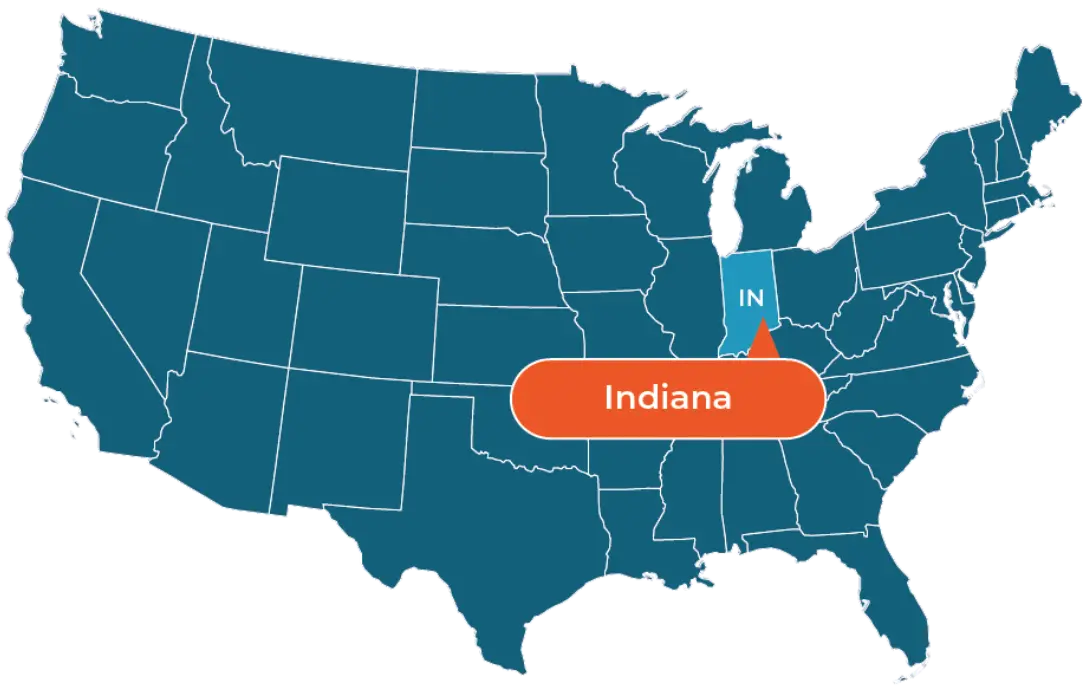
IFTA Reporting and Filing Requirements in Indiana
Who Needs IFTA Registration in Indiana?
You need an Indiana IFTA license if Indiana is your base jurisdiction and you operate qualified motor vehicles in Indiana and at least one other IFTA member jurisdiction, including a participating Canadian province.
Under Indiana’s IFTA requirements, a qualified motor vehicle is used to transport people or property and meets any of the following conditions:
- A vehicle with three or more axles, regardless of weight
- A combination of a power unit and trailing unit with a combined gross vehicle weight exceeding 26,000 pounds
- Any vehicle with a gross vehicle weight or registered gross vehicle weight exceeding 26,000 pounds
Indiana requires interstate carriers operating qualified motor vehicles to obtain an IFTA license and display valid IFTA decals.
If your fleet includes vehicles with International Registration Plan (IRP) plates that travel outside Indiana and vehicles with Indiana base plates that operate only within the state, you must maintain an IFTA license for your fleet.
Carriers that operate only within Indiana may instead be subject to Indiana’s Motor Carrier Fuel Tax (MCFT) program rather than IFTA.
How Do You Apply For an IFTA License in Indiana?
To open an Indiana IFTA account, submit a completed IFTA-1A Application, provide the required supporting documents, and pay the $25 application fee.
- Apply by Email or Fax Complete and sign the IFTA-1A Application.
You must also provide the documents listed in the IFTA New Account Checklist. Indiana provides separate document checklists based on whether the business operates from a commercial or residential property and whether it is a sole proprietorship, partnership, LLC, or corporation.
Gather the documents required for your business address and business structure, then email or fax the complete application package to:
FTSNewAccount@dor.in.gov or fax it to 317-615-7333.
You can pay your Indiana IFTA fees using the Indiana Credit Card Payment Authorization Form. Submit this form alongside your IFTA application. - Apply by Mail Complete the IFTA-1A Application and mail the signed application along with the required documentation and a $25 application fee payable to the Indiana Department of Revenue:
Indiana Department of Revenue
Motor Carrier Services
IFTA / MCFT Section
7811 Milhouse Road, Suite M
Indianapolis, IN 46241-9612 - Apply by Appointment Schedule an appointment with Indiana Department of Revenue Motor Carrier Services to submit your application, required documents, and $25 fee in person.
Once your application is approved, Indiana will issue one IFTA license for your account and one set of two IFTA decals for each qualified vehicle. A copy of the license must be carried in each qualified vehicle, while the original should be kept with your business records
What Are The IFTA Reporting Requirements in Indiana?
Indiana IFTA license holders must file quarterly fuel tax returns reporting the distance traveled and fuel purchased in each IFTA member jurisdiction where their qualified motor vehicles operated. A return is required for every quarter in which the carrier holds an active IFTA license, even if the fleet had no activity
To complete your quarterly IFTA return, you must maintain accurate records of:
- Total and taxable miles traveled in each jurisdiction
- Fuel purchased by jurisdiction and fuel type
- Fuel receipts, invoices, and other records supporting tax-paid fuel purchases
- Trip and distance records identifying the vehicle, route, dates of travel, and miles traveled
To close an Indiana IFTA account, all required returns must be filed, outstanding balances must be paid, and the license cards and assigned decals must be returned. If the credentials are not returned, you must continue filing quarterly returns through the end of the license year, including returns with no activity.
Motor carriers must maintain complete and accurate records to support reported mileage and fuel usage. ELD data may support these records, but additional documentation may be needed to meet Indiana’s IFTA recordkeeping requirements.
Indiana allows carriers to manage quarterly filings, payments, renewals, and decal orders through its online Fuel Tax System.
How Do You File an IFTA Report in Indiana?
Indiana requires IFTA license holders to file quarterly fuel tax returns electronically through the Indiana Fuel Tax System (FTS).
-
Prepare Your IFTA Report
Before filing your quarterly return, gather the records needed to accurately report your operations, including:
- Total miles traveled in each jurisdiction
- Taxable miles traveled in each jurisdiction
- Tax-paid fuel purchases
- Number of qualified vehicles operated during the reporting period
Indiana requires a quarterly fuel tax return to be filed every quarter, including periods with no taxable activity.
-
Submit Your IFTA Return
Log in to the Indiana Fuel Tax System (FTS) and access your quarterly return.
Select the appropriate fuel types and the jurisdictions where your vehicles operated during the reporting period. Enter your total miles, taxable miles, tax-paid gallons, and number of qualified vehicles.
Review the information, calculate your fuel tax liability, and submit the return electronically. If fuel tax is owed, payment can be made after the return is submitted. Indiana also allows carriers to manage renewals, payments, and decal orders through the Fuel Tax System.
When is Quarterly IFTA Filing Due in Indiana?
You must file Indiana IFTA returns quarterly using the following schedule:
| Indiana Reporting Period | Indiana IFTA Filing Deadline |
|---|---|
| January – March (1st Quarter) | April 30 |
| April – June (2nd Quarter) | July 31 |
| July – September (3rd Quarter) | October 31 |
| October – December (4th Quarter) | January 31 |
If a deadline falls on a Saturday, Sunday, or legal holiday, the return is due on the next business day.
What Are the IFTA License Costs and Fees in Indiana?
Indiana charges a $25 application fee for a new IFTA license. Applicants must submit the fee along with Form IFTA-1A when applying for an Indiana IFTA account.
Once approved, Indiana issues one set of IFTA decals for each qualified vehicle covered under the license.
Indiana also charges a $25 reinstatement fee if an IFTA license has been revoked. The carrier must file all required returns and pay any outstanding liabilities before the license can be reinstated.
In addition to licensing fees, carriers may be responsible for fuel taxes, penalties, and interest resulting from late filings, late payments, or failure to comply with Indiana’s IFTA requirements.
Carriers can use Indiana’s online Fuel Tax System to manage renewals, order additional decals, and obtain 30-day permits.
What Are The IFTA Penalties and Interest in Indiana?
Indiana imposes penalties and interest when IFTA license holders fail to file quarterly tax returns, file late returns, or fail to pay the full amount of fuel tax due.
The penalty for a late IFTA return or late payment is the greater of:
- $50, or
- 10% of the net tax due to all IFTA member jurisdictions
Interest is also charged on unpaid fuel taxes in accordance with IFTA requirements.
When a required return is not filed, Indiana may estimate the carrier’s tax liability using the best information available. If adequate records are unavailable, the Department of Revenue may use a standard fuel economy of 4 miles per gallon or reduce the carrier’s reported fuel economy by 20%.
A carrier that fails to file a quarterly IFTA report may also be subject to a $300 civil penalty for each unfiled report.
Failure to file returns, pay taxes due, or comply with IFTA requirements may result in license revocation. A revoked license may be reinstated after all required returns are filed, outstanding liabilities are paid, and the $25 reinstatement fee is submitted
How Do You Renew an IFTA License in Indiana?
Indiana IFTA licenses must be renewed annually through the Indiana Fuel Tax System (FTS).
To renew your Indiana IFTA license:
- Log in to your Indiana Fuel Tax System (FTS) account.
- Select the renewal option for your IFTA account.
- Review and update your business and vehicle information, if necessary.
- Verify the number of decals needed for the upcoming license year.
- Submit your renewal application electronically.
Annual fuel tax renewals begin September 15 and are due by November 15. The Indiana Department of Revenue recommends submitting your renewal by November 1 to help ensure you receive your license credentials and decals on time.
After your renewal is processed, you can continue to manage your account, file returns, make payments, and order additional decals through the Fuel Tax System.
Important IFTA Documents & Online Filing in Indiana
- Application for Indiana Fuel Tax License: Form IFTA-1A – International Fuel Tax Agreement Application
- Indiana IFTA Fuel Tax Report: Quarterly IFTA returns are filed electronically through the Indiana Fuel Tax System (FTS).
- Online Indiana Filing for IFTA: Indiana Fuel Tax System (FTS)
- Indiana Tax Rates for IFTA Quarters: IFTA Tax Rate Matrix
- Indiana IFTA Tax Phone #: (317) 615-7200
- Indiana IFTA Tax Email: Indianamotorfuel@dor.in.gov
- IFTA User Guide: How to File an IFTA Quarterly Tax Return
- Additional Indiana IFTA Resources:
Simplify Your IFTA Reporting with eIFTA by Truckopedia
Skip manual calculations and generate accurate, file-ready IFTA reports in minutes. eIFTA by Truckopedia helps you organize mileage and fuel data, calculate fuel taxes automatically, and prepare reports ready for filing with your base jurisdiction.
With eIFTA, you can:
- Import mileage and fuel purchase data with ease
- Automatically apply the latest IFTA tax rates for each quarter
- Instantly calculate taxes owed or credits due
- Generate file-ready IFTA reports for review and submission
Whether you’re an owner-operator or managing a fleet, eIFTA helps reduce reporting errors, save time, and simplify quarterly IFTA compliance.

Accurate IFTA Reports for Your State—Ready in Minutes
Simplify your quarterly IFTA reporting with accurate, state-based calculations.