
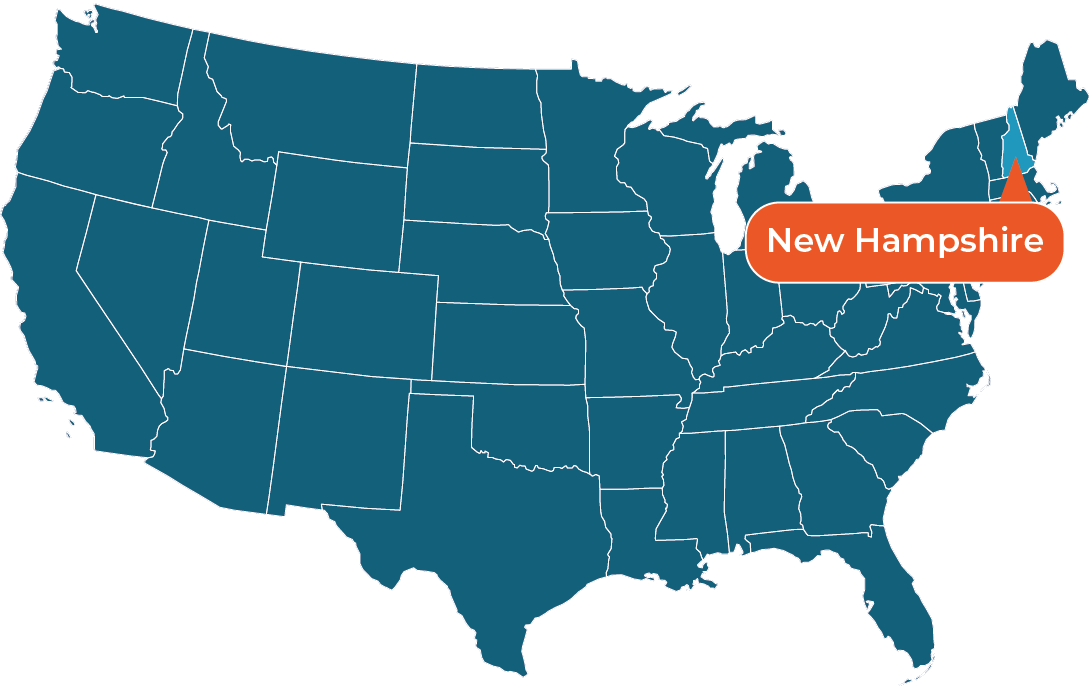
IFTA Reporting and Filing Requirements in New Hampshire
Who Needs IFTA Registration In New Hampshire?
If New Hampshire is your base jurisdiction, you must register for a International Fuel Tax (IFTA) license if you operate a qualified motor vehicle in New Hampshire and at least one other IFTA member jurisdiction. A New Hampshire IFTA license allows you to report and pay fuel taxes through a single quarterly return instead of filing separately in each IFTA jurisdiction where you operate.
A qualified motor vehicle is one that is used, designed, or maintained to transport people or property and meets any of the following criteria:
- Has two axles and a gross vehicle weight or registered gross vehicle weight exceeding 26,000 pounds
- Has three or more axles, regardless of weight
- Is used in combination when the combined gross vehicle weight or registered gross vehicle weight exceeds 26,000 pounds
Recreational vehicles used exclusively for personal purposes are not considered qualified motor vehicles under IFTA.
New Hampshire may serve as your base jurisdiction when your qualified vehicles are based there for registration purposes, your operational control and records are maintained or can be made available in New Hampshire, and your fleet travels within the state.
If your qualified vehicles operate only within New Hampshire, you do not need an IFTA license. Instead, you must comply with applicable New Hampshire fuel tax requirements. Carriers that operate interstate only occasionally may also use temporary fuel permits where permitted rather than maintaining an IFTA license.
For complete eligibility requirements and licensing information, visit the New Hampshire DMV – International Fuel Tax Agreement (IFTA) page
How To Apply For An IFTA License In New Hampshire
If New Hampshire is your base jurisdiction, you must apply for an International Fuel Tax Agreement (IFTA) license through the New Hampshire Division of Motor Vehicles (DMV) – Bureau of Road Toll before operating qualified motor vehicles in two or more IFTA member jurisdictions.
- Complete The IFTA Application Complete the New Hampshire IFTA Application by providing the required business information, including your legal business name, business address, Federal Employer Identification Number (FEIN), USDOT number, contact information, and details about your qualified motor vehicles.
Before submitting your application, review all information to ensure it is complete and accurate. - Submit Your Application Submit your completed application and required payment by mail to the New Hampshire DMV – Bureau of Road Toll
If you need assistance with the application or required documentation, contact or visit the the Bureau of Road Toll at its new location,
New Hampshire Department of Safety
Bureau of Road Toll
101 Pleasant Street
Concord, NH
Phone: (603) 223-8000, option 2.
Email: RoadToll@dos.nh.gov - Receive Your IFTA Credentials Once your application is approved, the Bureau of Road Toll will issue:
- An IFTA license.
- One set of IFTA decals for each qualified motor vehicle.
If you need additional decals, replacement credentials, or assistance with your IFTA account, contact the New Hampshire Department of Safety– Bureau of Road Toll using the contact information listed above.
What Are The IFTA Reporting Requirements In New Hampshire?
If New Hampshire is your base jurisdiction for IFTA, you must file an IFTA quarterly tax return with the New Hampshire Division of Motor Vehicles (DMV) – Bureau of Road Toll every calendar quarter. You are required to file a return even if you did not operate a qualified motor vehicle, travel any taxable miles, or purchase taxable fuel during the reporting period. In these cases, you must submit a zero return.
If New Hampshire is your base jurisdiction for IFTA, you must file an IFTA quarterly tax return with the New Hampshire Department of Safety – Road Toll Bureau every calendar quarter. You must file a return even if you had no IFTA operations during the reporting period. In this case, you must submit a zero return.
Each New Hampshire IFTA quarterly tax return should include:
- Total miles traveled in IFTA and non-IFTA jurisdictions.
- Total gallons of fuel used, reported by fuel type.
- Average fleet miles per gallon (MPG).
- Total and taxable miles traveled in each IFTA jurisdiction.
- Tax-paid gallons purchased in each jurisdiction.
- The resulting fuel tax due or credit for each jurisdiction.
To support your quarterly filings, maintain accurate mileage and fuel records for each qualified motor vehicle, including trip records, fuel receipts, and bulk fuel records, if applicable. IFTA records must generally be retained for four years from the return due date or filing date, whichever is later, and made available if requested during an audit.
New Hampshire IFTA license holders can file quarterly returns electronically through the New Hampshire Motor Carrier Connect Portal. The online system also allows carriers to make payments, renew their IFTA license, order decals, and communicate with the Road Toll Bureau.
For additional reporting requirements and filing guidance, visit the New Hampshire DMV – International Fuel Tax Agreement (IFTA) page.
How Do You File An IFTA Report In New Hampshire?
New Hampshire IFTA license holders can file their quarterly IFTA tax returns electronically through the New Hampshire Motor Carrier Connect Portal, the state’s online IFTA system administered by the New Hampshire Department of Safety – Road Toll Bureau.
-
Gather Your Records
Before filing your New Hampshire IFTA quarterly tax return, collect the records needed to accurately report your fuel use and mileage, including:
- Total miles traveled in each IFTA member jurisdiction.
- Taxable miles traveled by jurisdiction.
- Total gallons of fuel purchased, reported by fuel type.
- Tax-paid fuel purchases by jurisdiction.
- Trip reports, mileage records, fuel receipts, and bulk fuel records (if applicable).
Maintaining complete and accurate records helps ensure your return is filed correctly and provides the documentation required if your account is selected for an IFTA audit.
-
Complete And Submit Your Return
New Hampshire IFTA license holders can file their quarterly returns online through the New Hampshire Motor Carrier Connect Portal.
Once logged in:
- Select the appropriate reporting year and quarter.
- Enter your mileage by jurisdiction.
- Report fuel use and tax-paid fuel purchases by jurisdiction and fuel type.
- Review the calculated fuel tax due or credit.
- Submit your return and pay any balance due, if applicable.
You can also file your IFTA return by mail using Form IFTA-100, IFTA Quarterly Fuel Use Tax Return, and Form IFTA-101, IFTA Quarterly Fuel Use Tax Schedule. To obtain current paper forms and filing instructions, contact the New Hampshire IFTA office at (603) 271-2311 or nhifta@dos.nh.gov.
Completed paper returns can be mailed to:
State of New Hampshire
Department of Safety
Road Toll Bureau
33 Hazen Drive, Room 106A
Concord, NH 03305
-
File A Return Every Quarter
New Hampshire requires all IFTA license holders to file a quarterly tax return, even if they had no operations during the reporting period. If you did not operate in any jurisdiction during the quarter, you must still submit a no-operation return.
For additional filing information and account assistance, visit the New Hampshire Motor Carrier Connect Portal or contact the New Hampshire IFTA office.
When Is Quarterly IFTA Filing Due In New Hampshire?
New Hampshire IFTA license holders must file an IFTA quarterly tax return for each calendar quarter. Returns are due on the last day of the month following the end of each reporting quarter.
The quarterly IFTA filing deadlines are:
| Reporting Period | Filing Deadline |
|---|---|
| January – March (1st Quarter) | April 30 |
| April – June (2nd Quarter) | July 31 |
| July – September (3rd Quarter) | October 31 |
| October – December (4th Quarter) | January 31 |
If a filing deadline falls on a Saturday, Sunday, or legal holiday, the return is due on the next business day.
New Hampshire requires IFTA license holders to file a quarterly return even if they had no operations during the reporting period. If you did not operate in any jurisdiction during the quarter, you must still submit a no-operation return.
What Are The IFTA License Costs And Fees In New Hampshire?
New Hampshire does not charge a separate fee for the IFTA license certificate. However, carriers must pay $10 for each set of IFTA decals issued for a qualified motor vehicle.
The current New Hampshire IFTA fees are:
| New Hampshire IFTA Item | Fee |
|---|---|
| IFTA license certificate | No separate fee |
| IFTA decal set (two decals per qualified motor vehicle) | $10 per set |
Each qualified motor vehicle operating under a New Hampshire IFTA license must display one decal on each side of the cab and carry the IFTA license or a copy of the license while operating outside New Hampshire.
If you need additional or replacement decals, contact the New Hampshire Department of Safety – Road Toll Bureau for current procedures and fees.
What Are The IFTA Penalties And Interest In New Hampshire?
If you file your New Hampshire IFTA return late, fail to file a required return, or underpay the fuel tax due, you may be subject to penalties and interest.
Under IFTA rules, New Hampshire may assess a penalty of $50 or 10% of the delinquent tax, whichever is greater, for failing to file a return, filing late, or underpaying the tax due. IFTA guidance specifically provides for this penalty calculation on delinquent returns.
Interest is also assessed on unpaid IFTA taxes owed to each jurisdiction. The 2026 IFTA interest rate is 9% annually, calculated monthly at one-twelfth of the annual rate. The rate is adjusted each year and may change for future reporting periods.
Continued failure to file required returns or pay amounts due can also result in additional enforcement action, including suspension or revocation of IFTA operating privileges under the IFTA Agreement.
To avoid penalties and interest, file each required New Hampshire IFTA return and pay the full amount due by the quarterly filing deadline.
How Do You Renew An IFTA License In New Hampshire?
New Hampshire IFTA licenses must be renewed annually through the New Hampshire Division of Motor Vehicles (DMV) – Bureau of Road Toll. To avoid interruptions to your interstate operations, complete your renewal before your current IFTA credentials expire.
- Review Your IFTA Account Before renewing your New Hampshire IFTA license, verify that your business information is current, including your business name, mailing address, contact information, and qualified motor vehicle details.
If any information has changed, update your account before submitting your renewal application. - Ensure Your Account Is In Good Standing Before your renewal can be processed, make sure you have:
- Filed all required IFTA quarterly tax returns.
- Paid all outstanding fuel taxes, penalties, and interest.
- Resolved any compliance issues with the New Hampshire DMV – Bureau of Road Toll.
- Renew Your IFTA License Existing license holders can renew their IFTA credentials through the New Hampshire Motor Carrier Connect Portal. Once your renewal is processed, the Bureau of Road Toll will issue:
- A renewed IFTA license.
- A new set of IFTA decals for each qualified motor vehicle.
For renewal assistance or additional information, visit the New Hampshire DMV – International Fuel Tax Agreement (IFTA) page.
Important IFTA Documents & Online Filing In New Hampshire
The following official resources from the New Hampshire Division of Motor Vehicles (DMV) – Bureau of Road Toll can help you apply for an IFTA license, file quarterly tax returns, renew your credentials, and manage your New Hampshire IFTA account.
- New Hampshire DMV – IFTA Home Page: https://www.dmv.nh.gov/international-fuel-tax-agreement-ifta
- New Hampshire Motor Carrier Connect Portal: https://nh.motorcarrierconnect.com/Identity/UserAccount/CreateSelfSignup
- New Hampshire DMV Forms & Documents: https://www.dmv.nh.gov/forms-and-documents
- New Hampshire IFTA Application: https://www.dmv.nh.gov/sites/g/files/ehbemt416/files/inline-documents/sonh/2025iftaapplicationrt129.pdf
- New Hampshire DMV Contact Information: https://www.dmv.nh.gov/contact-us
- IFTA, Inc. Tax Rates: https://www.iftach.org/
Simplify New Hampshire IFTA Reporting with eIFTA by Truckopedia
Preparing quarterly New Hampshire IFTA returns does not have to be complicated. eIFTA by Truckopedia helps owner-operators and fleet managers turn mileage and fuel purchase data into accurate, file-ready IFTA reports.
With eIFTA, you can:
- Generate accurate New Hampshire IFTA reports in minutes
- Calculate fuel taxes using current IFTA tax rates
- Track mileage and fuel purchases across IFTA member jurisdictions
- Reduce manual calculations and reporting errors
- Keep your records organized for quarterly filing and IFTA audits
Whether you operate one truck or manage a fleet across multiple IFTA member jurisdictions, eIFTA helps simplify quarterly fuel tax reporting so you can spend less time on paperwork and more time on the road.

Accurate IFTA Reports for Your State—Ready in Minutes
Simplify your quarterly IFTA reporting with accurate, state-based calculations.