
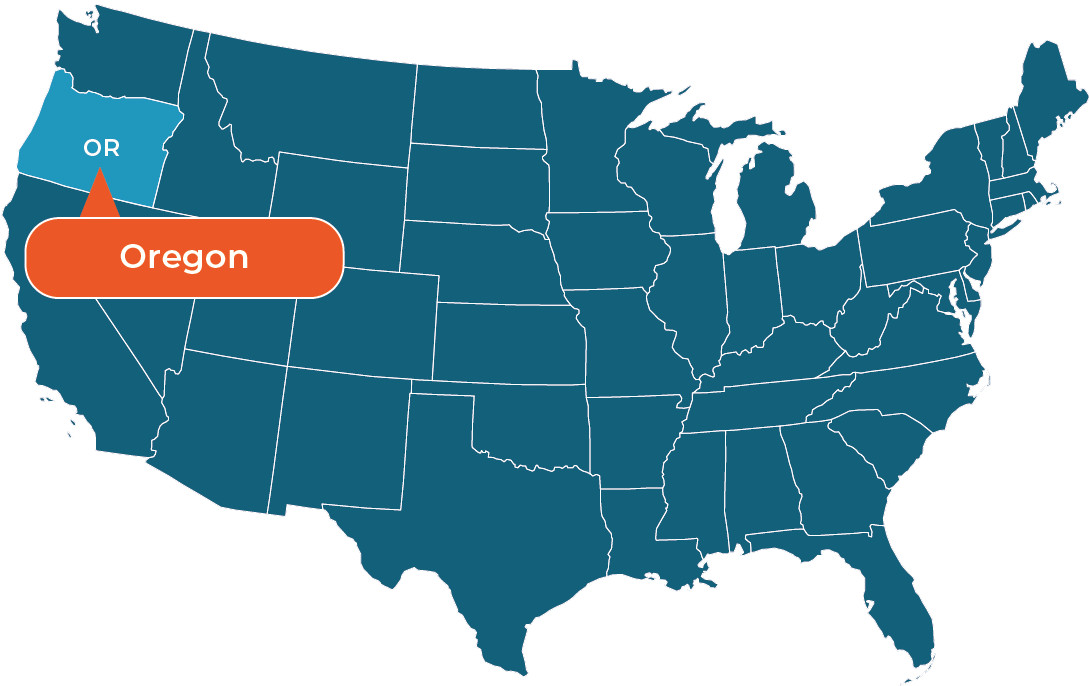
IFTA Reporting And Filing Requirements In Oregon
Who Needs IFTA Registration in Oregon?
You must register for an Oregon IFTA license if your business is based in Oregon and you operate one or more qualified motor vehicles in Oregon and at least one other IFTA member jurisdiction. In Oregon, IFTA is administered by the Oregon Department of Transportation (ODOT), Commerce and Compliance Division (CCD).
If your qualified motor vehicles operate only within Oregon, you generally do not need an Oregon IFTA license. However, vehicles operating in Oregon at a gross weight above 26,000 pounds may still be subject to Oregon’s weight-mile tax requirements.
A qualified motor vehicle is one that is used, designed, or maintained to transport people or property and meets any of the following criteria:
- Has two axles and a gross vehicle weight or registered gross vehicle weight exceeding 26,000 pounds
- Has three or more axles, regardless of weight
- Is used in combination when the combined gross vehicle weight or registered gross vehicle weight exceeds 26,000 pounds
Recreational vehicles are not considered qualified motor vehicles for IFTA purposes.
If a vehicle displays Oregon IFTA decals, its mileage and fuel activity must be included on your quarterly Oregon IFTA tax return, even if it operated only in Oregon or had no operations during the reporting period. Oregon IFTA licensees must also file any required Oregon weight-mile tax reports separately.
If you choose not to obtain an Oregon IFTA license, you must obtain the required temporary fuel tax permits from each IFTA jurisdiction where your qualified motor vehicles operate.
How Do You Apply for an IFTA License in Oregon?
You can apply for an Oregon IFTA license through the Oregon Department of Transportation (ODOT) – Commerce & Compliance Division (CCD). Oregon offers three ways to apply: online, by mail, or in person.
- Apply Online The fastest way to apply is through Oregon Trucking Online (TOL), ODOT’s official online portal for motor carriers. Through TOL, you can apply for an Oregon IFTA account, manage your credentials, file quarterly IFTA returns, order decals, and renew your license.
- Complete the Oregon IFTA Application by Mail Complete the Oregon Application for IRP and/or IFTA, Form 735-9908. You can use this combined application to apply for an IFTA license, IRP registration, or both.
If you do not already have an Oregon motor carrier account, you may also need to submit the Oregon Motor Carrier Account Application, Form 735-9075. Corporations and other business entities must be registered with the Oregon Secretary of State unless the applicant is a sole proprietor.
When applying, you will be asked to provide information including:- Your USDOT number
- Your FEIN, TIN, or SSN, as applicable
- Your legal business name and contact information
- Your physical and mailing addresses
- Information about any previous IFTA account
- Jurisdictions where you maintain bulk fuel storage
- The number of IFTA decal pairs requested
Oregon Department of Transportation
Commerce and Compliance Division
455 Airport Road SE, Building A
Salem, OR 97301
You may also fax the application to 503-378-5765 or submit it in person at the Salem or Portland Metro CCD office. All mailed applications should be sent to the Salem headquarters.
The current Portland Metro office is:
18101 SW Boones Ferry Road, Suite 150
Portland, OR 97224
Phone: 971-673-5900
Appointments receive priority, although walk-in service is available. - Pay the License Fee and Receive Your Credentials Oregon charges an annual IFTA license fee based on the number of qualified vehicles in your fleet. The fee schedule begins at $280 for one qualified vehicle and increases according to fleet size. Qualifying farm fleets may pay a $50 flat fee.
Once your application is approved, Oregon will issue one IFTA license for the account and one pair of decals for each qualified motor vehicle. A copy of the license must be carried in each qualified motor vehicle, and one decal must be displayed on each side of the vehicle.
After your Oregon motor carrier account is established, you can use Oregon Trucking Online to manage account information, file quarterly returns, renew credentials, and request additional decals.
What Are the IFTA Reporting Requirements in Oregon?
If Oregon is your base jurisdiction under the International Fuel Tax Agreement (IFTA), you must file an Oregon IFTA tax return with the Oregon Department of Transportation (ODOT) – Commerce & Compliance Division for every calendar quarter. You must file a return even if no fuel tax is due, your vehicles operated only in Oregon, or you had no operations during the reporting period.
If you are also subject to Oregon’s weight-mile tax, you must file the required weight-mile tax report separately from your quarterly IFTA return.
Your Oregon IFTA report must include:
- Total miles traveled in IFTA jurisdictions, including Oregon
- Total miles traveled in non-IFTA jurisdictions, if applicable
- Total fuel volume placed into qualified motor vehicles
- Average fleet miles per gallon equivalent, or MPGe
- Total miles, taxable miles, taxable fuel volume, tax-paid fuel volume, and net taxable fuel volume for each IFTA jurisdiction
Oregon’s return requires operations for all vehicles displaying Oregon IFTA decals to be reported, including vehicles that did not leave Oregon during the reporting period.
You can file your quarterly return electronically through Oregon Trucking Online (TOL) or mail the completed Oregon IFTA Tax Return (Form 735-9740) to the Oregon Department of Transportation. However, if you operated during the reporting period but did not accrue any miles in Oregon, you cannot file the return online and must use the paper filing process.
If your qualified vehicles operated only in Oregon during the reporting period, check the “Oregon Operations Only” box and report your Oregon miles, fuel type, and total fuel volume purchased in Oregon. If none of your qualified vehicles operated during the quarter, check the “No Operations” box and submit the return.
Oregon requires you to maintain distance records, fuel records, monthly summaries, and bulk fuel records, if applicable, for at least four years from the due date of the return or the date it was filed, whichever is later. During an audit, failure to maintain adequate records may result in the loss of tax-paid fuel credits, the assessment of a 4.0 MPGe fleet average, or both.
For current fuel tax rates, refer to the official IFTA Tax Matrix.
How Do You File an IFTA Report in Oregon?
Oregon IFTA license holders must file a quarterly fuel tax return with the Oregon Department of Transportation (ODOT) – Commerce & Compliance Division (CCD). You can submit your return electronically through Oregon Trucking Online (TOL) or mail the completed Oregon IFTA Tax Report (Form 735-9740) to ODOT. You must file a return for every calendar quarter, even if you had no operations or no fuel tax due.
-
Prepare Your IFTA Report
Before filing your Oregon IFTA report, gather:
- Total miles traveled in all IFTA jurisdictions, including Oregon
- Total miles traveled in non-IFTA jurisdictions
- Total taxable miles traveled in each IFTA jurisdiction
- Total fuel volume placed into qualified motor vehicles, by fuel type
- Tax-paid fuel volume purchased in each IFTA jurisdiction
- Distance records, trip reports, fuel receipts, and bulk fuel records, if applicable
If your qualified vehicles operated only in Oregon, check the “Oregon Operations Only” box and report your Oregon miles, fuel type, and total fuel volume purchased in Oregon. If none of your qualified vehicles operated during the quarter, check the “No Operations” box.
Oregon requires you to retain supporting distance and fuel records for at least four years from the due date of the return or the date it was filed, whichever is later. During an audit, inadequate records may result in the loss of tax-paid fuel credits, the assessment of a 4.0 MPG fleet average, or both.
-
Submit Your IFTA Return
Log in to Oregon Trucking Online (TOL) to file your quarterly IFTA return electronically, or mail the completed Oregon IFTA Tax Report (Form 735-9740) to ODOT.
Before submitting your return:
- Verify your total miles traveled and total fuel volume.
- Report taxable miles and tax-paid fuel volume for each IFTA jurisdiction.
- Review your calculated tax due or credit.
- Submit the return and pay any balance due by the quarterly filing deadline.
When filing by mail, the return must be completed, signed, and postmarked by the due date. Include a check or money order payable to ODOT with IFTA written in the memo line if payment is due.
If you operated during the reporting period but did not accrue any miles in Oregon, you cannot file through Oregon Trucking Online. You must file Form 735-9740 by mail and include an explanation stating why the fleet did not accrue Oregon miles.
When is Quarterly IFTA Filing Due in Oregon?
File your Oregon IFTA returns quarterly, using the following schedule:
| Oregon Reporting Period | Oregon IFTA Filing Deadline |
|---|---|
| January – March (1st Quarter) | April 30 |
| April – June (2nd Quarter) | July 31 |
| July – September (3rd Quarter) | October 31 |
| October – December (4th Quarter) | January 31 |
You can file your quarterly return electronically through Oregon Trucking Online (TOL) or mail your completed return to ODOT. For paper returns, a filing is considered timely if it is postmarked by the U.S. Postal Service on or before the filing deadline.
If the filing deadline falls on a Saturday, Sunday, or legal holiday, Oregon follows the IFTA rule that your return is considered timely if it is filed or postmarked on the next business day.
Why Are Oregon’s IFTA Fees Higher Than Those in Many Other States?
Oregon uses a state-specific, fleet-based IFTA license fee rather than a single flat fee. The annual fee increases according to the maximum number of IFTA-qualified vehicles operated during the year. IFTA does not set this amount; member jurisdictions may charge license and decal fees authorized under their own laws.
Oregon’s IFTA license fee is separate from both the fuel taxes calculated on quarterly IFTA returns and Oregon’s weight-mile tax. Although ODOT administers these programs as part of its broader motor carrier system, ODOT does not publish a detailed explanation showing why its IFTA fee schedule is higher or stating that the fees fund the weight-mile tax program. The most accurate explanation is simply that Oregon has adopted an unusually high, tiered license-fee structure based on fleet size.
What Are the IFTA License Costs and Fees in Oregon?
The Oregon Department of Transportation (ODOT) – Commerce & Compliance Division (CCD) charges an annual IFTA license fee based on the number of qualified motor vehicles in your fleet. When applying for or renewing an Oregon IFTA license, you must pay the applicable fee according to the current fee schedule.
| Number of Qualified Vehicles | Annual License Fee |
|---|---|
| 1 | $280 |
| 2 | $295 |
| 3 | $310 |
| 4 | $325 |
| 5 | $340 |
| 6 | $355 |
| 7 | $370 |
| 8 | $385 |
| 9 | $400 |
| 10 | $415 |
| 11 | $430 |
| 12 | $445 |
| 13 | $460 |
| 14 | $475 |
| 15 | $490 |
| 16–20 | $525 |
| 21 or more | $575 |
Oregon offers a $50 flat annual fee for qualifying farm fleets. To qualify, more than 50% of the fleet’s IFTA-qualified vehicles must have Oregon farm plates.
The annual license fee is based on the maximum number of IFTA-qualified vehicles operated during the calendar year. If you add vehicles and move into a higher fee level, you must pay the difference when requesting additional decals. Oregon does not provide a refund if the fleet later decreases in size.
What Are the IFTA Penalties and Interest in Oregon?
If you fail to file your Oregon IFTA tax return on time or do not pay the full fuel tax due by the filing deadline, the Oregon Department of Transportation (ODOT), Commerce and Compliance Division, may assess penalties and interest.
The late filing or underpayment penalty is the greater of:
- $50, or
- 10% of the delinquent tax
This penalty may apply even when only part of the tax due remains unpaid.
Interest is also charged on unpaid fuel tax owed to each jurisdiction. The interest rate is established annually under the IFTA Articles of Agreement, and interest accrues for each month or partial month from the original due date until the tax is paid.
If you do not maintain adequate distance and fuel records, ODOT may:
- Assess your fleet’s fuel mileage at 4.0 miles per gallon
- Disallow tax-paid fuel credits that cannot be supported by valid records
- Assess additional fuel tax, penalties, and interest based on the audit findings
Failure to file required returns or resolve outstanding tax liabilities may result in the revocation of your Oregon IFTA license. To reinstate a revoked account, you must correct all outstanding deficiencies and pay ODOT’s $25 reinstatement fee.
You may request a waiver of an assessed penalty. However, Oregon cannot waive interest owed to another IFTA jurisdiction; you must contact that jurisdiction directly to request consideration.
To avoid penalties and interest, file your quarterly return through Oregon Trucking Online or submit a properly completed paper return, along with any payment due, by the applicable filing deadline. You must file a return even if you had no operations or no tax is due.
How Do You Renew an IFTA License in Oregon?
You must renew your Oregon IFTA license each year through the Oregon Department of Transportation (ODOT), Commerce and Compliance Division (CCD). Oregon IFTA licenses are valid for the calendar year and expire on December 31. Online renewal typically opens in October.
- Start Your IFTA Renewal Log in to Oregon Trucking Online (TOL) and select the renewal option. Motor carriers already registered to operate in Oregon can sign up for a TOL account and password if they do not already have online access.
Oregon also allows IFTA renewals to be submitted by mail or in person at an ODOT Commerce and Compliance Division office. Appointments receive priority, but walk-in service is available. - Review Your Account and Pay the Renewal Fee Review your contact information, bulk-fuel storage status, and the number of qualified motor vehicles operating under your IFTA license. Pay the applicable annual IFTA license fee, which is based on the number of qualified vehicles in your fleet.
Before renewing, make sure your USDOT status is current and in good standing. Your prior IFTA license must not be revoked or canceled, and all deficiencies on your Oregon IFTA account must be paid or resolved. If deficiencies remain, Oregon may hold or return your renewal without processing it. - Receive Your License and Decals When you renew online, Oregon issues an electronic IFTA license immediately through TOL. Your new IFTA decals will be mailed to you. A legible electronic copy of the license may be carried in each qualified motor vehicle and is acceptable in all IFTA member jurisdictions.
Each qualified motor vehicle must display two current IFTA decals, with one decal on each side of the cab. Oregon issues one IFTA license for the account, so you must make copies or provide an electronic copy for each qualified vehicle.
Oregon provides a two-month credential-display grace period during January and February for carriers who have renewed their IFTA licenses. Current-year licenses and decals must be displayed beginning March 1.
If your Oregon IFTA license has been revoked, you must satisfy all outstanding deficiencies and pay the $25 reinstatement fee before the account can be reinstated.
Important IFTA Documents & Online Filing in Oregon
- Online Oregon Filing for IFTA Oregon Trucking Online (TOL)
- Application for Oregon Fuel Tax License: https://www.oregon.gov/odot/Forms/Motcarr/9908fill.pdf
- Oregon IFTA Fuel Tax Report: https://www.oregon.gov/odot/Forms/Motcarr/9740.pdf
- Oregon IFTA Fuel Tax Report Supplement: https://www.oregon.gov/odot/Forms/Motcarr/9740.pdf
- (Form 735-9740c continuation sheet is included within as Oregon does not issue a separate supplement form.)
- Oregon Tax Rates for IFTA Quarters: https://www.iftach.org/taxmatrix4/Taxmatrix.php
- Oregon IFTA Tax Phone #: 503-373-1634
- Oregon IFTA Tax Email: CCDIFTA@odot.oregon.gov
- IFTA User Guide: https://www.oregon.gov/odot/MCT/Documents/MotorCarrierRegistrationandTaxManual.pdf
Simplify Oregon IFTA Reporting with eIFTA by Truckopedia
Preparing quarterly Oregon IFTA tax returns doesn’t have to be complicated. eIFTA by Truckopedia helps owner-operators and fleet managers turn mileage and fuel purchase data into accurate, file-ready IFTA reports.
With eIFTA, you can:
- Generate accurate Oregon IFTA reports in minutes.
- Calculate fuel taxes using the latest IFTA tax rates.
- Track mileage and fuel purchases across all IFTA member jurisdictions.
- Reduce manual calculations and reporting errors.
- Keep your records organized for quarterly IFTA filings and audits.
Whether you operate a single truck or manage a fleet across multiple IFTA member jurisdictions, eIFTA simplifies Oregon IFTA reporting so you can spend less time on paperwork and more time keeping your business moving.

Accurate IFTA Reports for Your State—Ready in Minutes
Simplify your quarterly IFTA reporting with accurate, state-based calculations.